A. ACCREDITED CONSULAR OFFICES (CONSULAR CORPS)
AUSTRIA
Hon. Consulate of Austria
P.O. Box 1027
416-A East Morris Street
LaConner, WA 98257
TEL:
(360) 466-0252
FAX: (360) 466-0252
Elisabeth C. Steinacker-Chapman
Hon. Consul
chapmanlawps@aol.com
BELGIUM
Hon. Consulate of Belgium
2200 Alaskan Way, Suite 470
Seattle, WA 98121
TEL:
(206) 728-5145
FAX: (206) 770-7923
H. Ronald Masnik
Hon. Consul
hrmasnik@hotmail.com
CAMBODIA
Hon.
Consulate of Cambodia
1818 Westlake Ave. N. #315
Seattle, WA 98109
TEL: (206) 217-0830
FAX: (206) 361-7888
Daravuth
Huoth
Hon. Consul
consul_huoth@diplomats.com
CANADA
Consulate General of Canada
1501 Fourth Avenue, Suite 600
Seattle, WA 98101-4328
TEL: (206) 770-4060
FAX: (206) 443-9662
Peter Lloyd
Consul General
Peter.Lloyd@international.gc.ca
Sheila.Keizer@international.gc.ca
CROATIA
Hon. Consulate of Croatia
7547 S. Laurel Street
Seattle, WA 98178
TEL: (206) 772-2968
FAX:
(206) 772-3487
Frank Brozovich, DDS
Hon. Consul
Fwbroz@comcast.net
CYPRUS
Hon. Consulate of Cyprus
5555 Lakeview, Suite 200
Kirkland, WA 98033
TEL: (425)
827-1700
FAX: (425) 889-0308
Vassos M. Demetriou
Hon. Consul
vmd@demetriou.net
ESTONIA
Hon. Consulate of Estonia
9133 View Avenue NW
Seattle, WA 98117
TEL: (206)
310-2153
Paul A. Raidna
Hon. Consul
Paulraidna@hotmail.com
ETHIOPIA
Hon. Consulate General of Ethiopia
P.O. Box 77447
Seattle, WA 98177
TEL: (206)
364-6401
Solomon Tadesse
Hon. Consul General
sosha@comcast.net
FINLAND
Hon. Consulate of Finland
17102 NE 37th Place
Bellevue, WA 98008
TEL: (425) 885-7320
FAX:
(425) 671-0706
Matti Suokko Hon. Consul
matti.suokko@finlandsea.org
FRANCE
Hon. Consulate of
France
World Trade Center
2200 Alaskan Way,
Suite 490
Seattle, WA 98121-1684
TEL: (206) 256-618
Jack
A. Cowan
Hon. Consuljackc@faccpnw.org
Yannis Lambourdieve
Consular assistant
consul@faccphw.org
GERMANY
Hon. Consulate of Germany
7853 SE 27th
Street, Suite 180
Mercer Island, WA 98040
TEL: (206) 230-5138
Petra Walker
Hon. Consul
Petrawwalker@gmail.com
HUNGARY
Hon. Consulate of Hungary
PO Box 578
Kirkland, WA 98083
TEL: (425) 739-0631
FAX:
(425) 739-6931
Helen M. Szablya
Hon. Consul
szablyahj@aol.com
ICELAND
Hon. Consulate General of Iceland
5610 20th Avenue NW
Seattle, WA 98107
TEL:
(206) 783-4100
FAX: (206) 784-8916
Jon Marvin Jonsson
Hon. Consul General
geirjonsson@yahoo.com
Geir Jonsson Hon. Vice Consul
5610 20th Ave N.W.
Seattle, WA 98107
TEL: (206) 783-4100
Geir@JonssonLaw.com
IRELAND
Hon.
Consulate of Ireland
5819 St. Andrews Dr.
Mukilteo, WA 98275
TEL: (425) 290-7839
John Keane, Hon. Consul
JKeane@IrishConsulSeattle.com
ITALY
Hon. Consulate of Italy
23718 7th Ave.
SE
Bothell, WA 98021
TEL: (206) 851-8023
FAX: (425) 489-0271
Franco Tesorieri, Hon. Vice Consulviceconsole@hotmail.com
JAMAICA
Hon. Consulate of Jamaica
8223 South 222nd St.
Kent, WA 98032
TEL: (253) 872-8950
FAX:
(253) 872-8953
Enid L. Dwyer
Hon. Consul
edwyer7636@aol.com
JAPAN
Consulate General of Japan
601 Union Street, Suite 500
Seattle,
WA 98101
TEL: (206) 682-9107
FAX: (206) 624-9097
www.cgjapansea.org
Mitsunori Namba
Consul General
cgassistant@cgjapansea.org
|
REPUBLIC OF KOREA
Consulate General
of The Republic of Korea
2033 6th Avenue,
Suite 1125
Seattle, WA 98121
TEL: (206) 441-1014
Haryong Lee Consul
Generalkcgseattle@gmail.com
LATVIA
Hon.
Consulate of Latvia
13517 69th Avenue S.E.
Snohomish, WA 98296
TEL:
(425) 773-0103
Stephen Zirschky
Hon. Consul
Stephenzirschky@hotmail.com
LITHUANIA
Hon. Consulate of Lithuania
5919 Wilson Ave. S.
Seattle, WA 98118
TEL: (206)
725-4576
Vytautas V .Lapatinskas
Hon. Consul
Vytasl@grybas.com
LUXEMBOURG
Hon. Consulate of Luxembourg
725 First Street South, Apt. 202
Kirkland, WA
98033
TEL: (425) 822-4607
Fred R. Cerf
Hon. Consul
Consulux@msn.com
MALTA
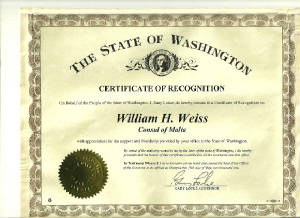
Hon. Consulate of Malta
P.O. Box 1104
Duvall, WA 98019
TEL: (425) 788-3120
FAX:
(425) 696-9374
Amb. William H.Weiss
Hon. Consul
Consulatewashington@hotmail.com
Web address:https://consulatewashington.tripod.com/
MEXICO
Consulate of Mexico
2132 Third Avenue
Seattle, WA 98121-2306
TEL: (206) 448-3526 ext 112
Marisela Quijano Herrero
Acting Consul
mquijano@sre.gob.mx
THE NETHERLANDS
Hon. Consulate of the Netherlands
40 Lake Bellevue
Suite
100
Bellevue, WA 98005
or/ P.O. Box 554
Kirkland, WA 98083
TEL: (425) 637-3050 Admin#
TEL: (206) 954-1961
Peter
Hageman
Hon. Consul
dhcseattle@aol.com
seattle@ncla.org etagratama@aol.com
NEW ZEALAND
Hon. Consulate of New Zealand
P.O Box 51059
Seattle,
WA 98115
TEL:
(206) 527-1896
Rachel Jacobsen, Hon. Consul
NZconsulseattle@gmail.com
NORWAY
Hon. Consulate of Norway
7301 Fifth Ave. NE, Suite A
Seattle, WA 98115
TEL: 206
284 2323
Kim Nesselquist
Hon. Consul
K.nesselquist@norway.com
RUSSIAN FEDERATION
Consulate General of
The Russian Federation
2001 6th Avenue,
Suite 2323
Seattle,
WA 98121
TEL: (206) 728-1910
Yury Gerasin
Consul General
consul@seanet.com
Nikolay Vinogradov
Deputy Con Gen
Nvinogradov@hotmail.com
SEYCHELLES
Hon. Consulate General of Seychelles
3620 S.W. 309th Street
Federal Way, WA 98023
TEL:
(253) 874-4579
FAX: (253) 838-2787
Anne Lise Church
Hon. Consul General
Lisechurch@comcast.net
SPAIN
Hon. Consulate of Spain
4709 139th Ave. S.E.
Bellevue, WA 98006
TEL: (425) 237-9373
FAX:
(425) 228-6239
Luis Esteban
Hon. Consul
Luis.f.bernaldez@boeing.com
SWEDEN
Hon. Consulate of Sweden
520 Pike Street Ste 2200
Seattle, WA 98101
TEL: (206) 467-8200
Lars
Jonsson
Hon. Consul
Lars@stellar.com
Seattle@consulateofsweden.org
SWITZERLAND
Hon. Consulate of Switzerland
6920 94th Ave. SE
Mercer Island, WA 98040-5442
TEL:
(206) 228-8110
FAX: (206) 236 8420
Philippe Goetschel
Hon. Consul
seattle@honorarvertretung.ch
TURKEY
Hon. Consulate General of Turkey
12328 NE 97th Street
Kirkland, WA
98033
TEL: (425) 739-6722
FAX: (425) 828-0571
John Gokcen
Hon. Consul General
john.u.gokcen@boeing.com
UGANDA
Hon. Consulate of Uganda
3226 Rosedale Street
Gig Harbor, WA 98335
TEL: (206) 571-9798
Bob
Goff
Hon Consul
Goff@ugandaconsulate.com
UNITED KINGDOM
Hon. Consulate of United Kingdom
500 108th Ave NE Suite 1500
Bellevue,
WA 98005
TEL: (425) 453-9400
Robert Cremin
Hon. Consul
Rcremin@esterline.com
UZBEKISTAN
Hon.
Consulate General of Uzbekistan
800 Fifth Ave. Suite 4000
Seattle, WA 98104
TEL: (206) 625-1199
FAX: (206) 292-9736
Gary
Furlong
Hon. Consul General
Uzbekconsulgeneral@gmail.com
B. FOREIGN ECONOMIC AND CULTURAL ORGANIZATIONS
Taipei Economic and Cultural Office
1 Union Square, Suite 2020
600 University Street
Seattle, WA 98101
TEL: (206) 441-4586
Daniel Liao
Director General
daniel.liao@hotmail.com
Richard Lin
Director
hclin@mofa.gov.tw
Jason Huang
Director
cshuang@mofa.gov.tw
|